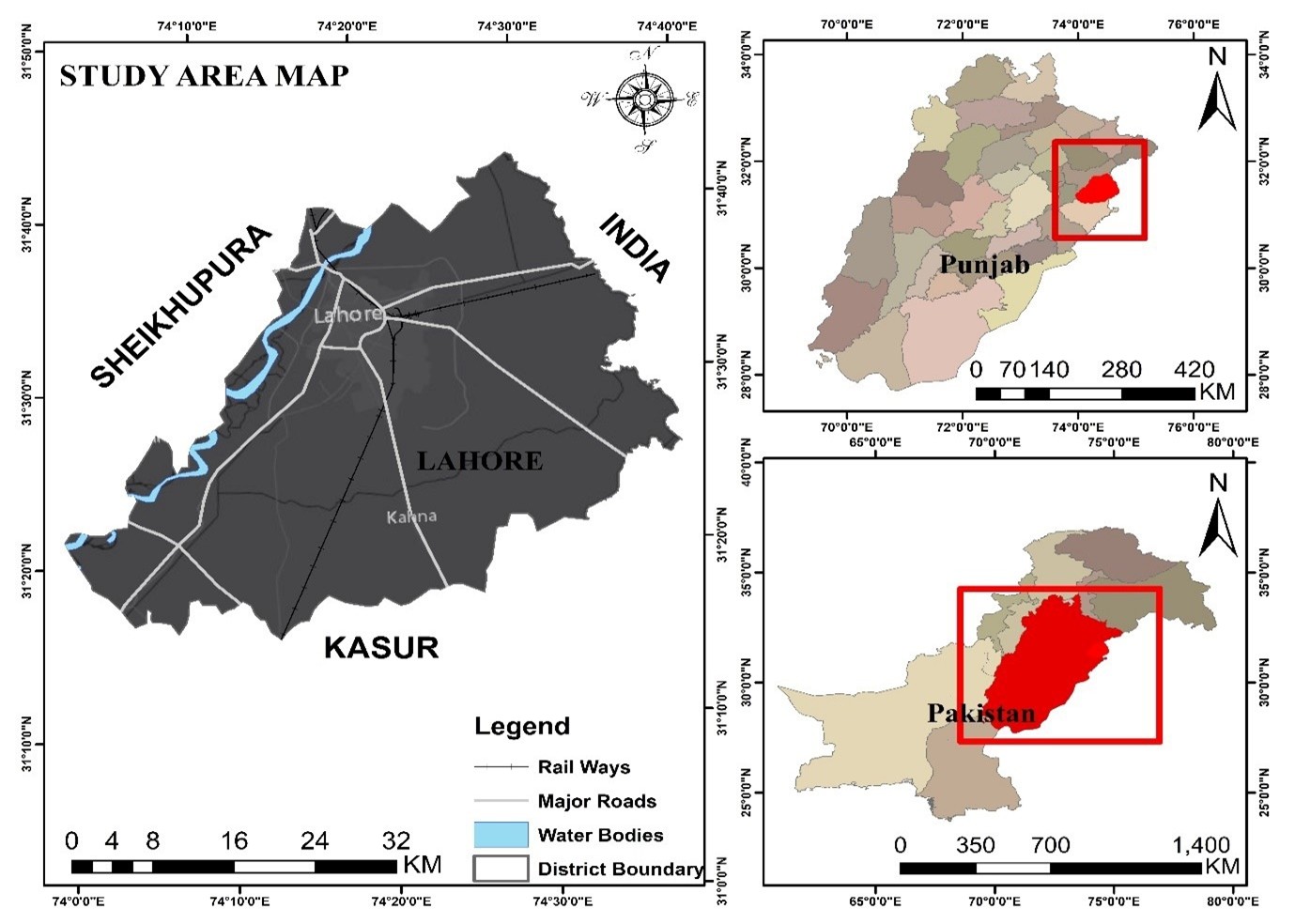
Geospatial Assessment of Land Use/Land Cover Change and Land Surface Temperature Dynamics Using Multi-Index Analysis and CA-Markov Modeling from 1990-2022 in Lahore, Pakistan
Keywords:
LST, Urbanization, LULC, Urban heat island, CA MarkovAbstract
The rapid urbanization has notably changed land use/ land cover (LULC) patterns of South Asian megacities, which intensifies the temperature of the land surface (LST) and urban heat islands. The consequences of urbanization on the climate and environment are critical for the natural resource management. This study examines long-term LULC dynamics and its effect on LST in Lahore, Pakistan, between 1990 and 2022 using multi-temporal Landsat data, various spectral indices and CA-Markov model to further predict future changes. Findings indicate that the vegetation cover decreased by about 71% in 1990 to 45.53% in 2022, with the settlement areas increasing by 13.54 to 36.78%. The overall accuracy of images ranged from 89 to 90%. Correspondingly, mean LST increased from 30 ºC up to more than 50 ºC. The correlation analysis showed that NDVI had strong negative correlation with LST but NDBI, NDBaI and NDWI and Urban Index had strong positive correlation with LST, demonstrating the importance of impervious and barren areas in intensifying heat. According to CA-Markov projections, settlement areas could increase more than 45% of the total area by 2050 with a further decrease in vegetation to almost 37%. These findings underline the importance of urban planning and sustainable land management that is climate sensitive so that the future thermal stress of rapidly growing cities can be reduced. The research also presents the understanding of LULC dynamics and promoting dialogs about the Sustainable Development Goals (SDGs)-climate action and building resilient cities and communities.
References
Abdulrahman, A. I., & Ameen, S. A. (2020). Predicting Land use and land cover spatiotemporal changes utilizing CA-Markov model in Duhok district between 1999 and 2033. Academic Journal of Nawroz University, 9(4), 71-80.
Aboulnaga, M., Trombadore, A., Mostafa, M., & Abouaiana, A. (2024). Understanding urban heat Island effect: causes, impacts, factors, and strategies for better livability and climate change mitigation and adaptation. In Livable Cities: Urban Heat Islands Mitigation for Climate Change Adaptation Through Urban Greening (pp. 283-366). Springer.
Ahmed, A., ul Hassan, S. N., Baig, S., Khan, M. Z., & Muhammad, A. (2019). The Response of Land Surface Temperature to the Changing Land-Use Land-Cover in a Mountainous Landscape under the Influence of Urbanization: Gilgit City as a case study in the Hindu Kush Himalayan Region of Pakistan: The Response of Land Surface Temperature to the Changing Land-Use Land-Cover in a Mountainous Landscape under the Influence of Urbanization: Gilgit City as a case study in the Hindu Kush Himalayan Region of Pakistan. International Journal of Economic and Environmental Geology, 10(3), 40-49.
Ali, M., Siddique, I., & Abbas, S. (2022). Characterizing air pollution and its association with emission sources in Lahore: A guide to adaptation action plans to control pollution and smog. Applied Sciences, 12(10), 5102.
Athick, A. M. A., Shankar, K., & Naqvi, H. R. (2019). Data on time series analysis of land surface temperature variation in response to vegetation indices in twelve Wereda of Ethiopia using mono window, split window algorithm and spectral radiance model. Data in brief, 27, 104773.
Azizi, P., Soltani, A., Bagheri, F., Sharifi, S., & Mikaeili, M. (2022). An integrated modelling approach to urban growth and land use/cover change. Land, 11(10), 1715.
Demisse Negesse, M., Hishe, S., & Getahun, K. (2024). LULC dynamics and the effects of urban green spaces in cooling and mitigating micro-climate change and urban heat island effects: a case study in Addis Ababa City, Ethiopia. Journal of Water and Climate Change, 15(7), 3033-3055.
Dutta, D., Rahman, A., Paul, S., & Kundu, A. (2019). Changing pattern of urban landscape and its effect on land surface temperature in and around Delhi. Environmental monitoring and assessment, 191(9), 551.
Dutta, D., Rahman, A., Paul, S., & Kundu, A. (2022). Spatial and temporal trends of urban green spaces: An assessment using hyper-temporal NDVI datasets. Geocarto International, 37(25), 7983-8003.
Ekaputri, R., Hidayat, T., Surtikanti, H., & Surakusumah, W. (2024). Modeling vegetation density with remote sensing, normalized difference vegetation index and biodiversity plants in watershed area. Global Journal of Environmental Science & Management (GJESM), 10(4).
Feng, L., Naz, I., Quddoos, A., Zafar, Z., Gan, M., Aslam, M., Hussain, Z. K., Soufan, W., & Almutairi, K. F. (2025). Exploring rangeland dynamics in Punjab, Pakistan: Integrating LULC, LST, and remote sensing for ecosystem analysis (2000–2020). Rangeland Ecology & Management, 98, 377-388.
Haque, M., & Basak, R. (2017). Land cover change detection using GIS and remote sensing techniques: a spatio-temporal study on Tanguar Haor, Sunamganj, Bangladesh. Egypt J Remote Sens Space Sci 20 (2): 251–263. In.
Huang, K., Li, X., Liu, X., & Seto, K. C. (2019). Projecting global urban land expansion and heat island intensification through 2050. Environmental Research Letters, 14(11), 114037.
Hussain, S., Mubeen, M., Ahmad, A., Majeed, H., Qaisrani, S. A., Hammad, H. M., Amjad, M., Ahmad, I., Fahad, S., & Ahmad, N. (2023). Assessment of land use/land cover changes and its effect on land surface temperature using remote sensing techniques in Southern Punjab, Pakistan. Environmental Science and Pollution Research, 30(44), 99202-99218.
Javed, N., & Riaz, S. (2019). Issues in urban planning and policy: The case study of Lahore, Pakistan. In New Urban Agenda in Asia-Pacific: Governance for sustainable and inclusive cities (pp. 117-162). Springer.
Jimenez-Munoz, J. C., Sobrino, J. A., Skoković, D., Mattar, C., & Cristobal, J. (2014). Land surface temperature retrieval methods from Landsat-8 thermal infrared sensor data. IEEE Geoscience and remote sensing letters, 11(10), 1840-1843.
Kaiser, E. A., Rolim, S. B. A., Grondona, A. E. B., Hackmann, C. L., de Marsillac Linn, R., Käfer, P. S., da Rocha, N. S., & Diaz, L. R. (2022). Spatiotemporal influences of LULC changes on land surface temperature in rapid urbanization area by using Landsat-TM and TIRS images. Atmosphere, 13(3), 460.
Karakuş, C. B. (2019). The impact of land use/land cover (LULC) changes on land surface temperature in Sivas City Center and its surroundings and assessment of Urban Heat Island. Asia-Pacific Journal of Atmospheric Sciences, 55(4), 669-684.
Lelieveld, J., Evans, J. S., Fnais, M., Giannadaki, D., & Pozzer, A. (2015). The contribution of outdoor air pollution sources to premature mortality on a global scale. Nature, 525(7569), 367-371.
Liu, J., Hagan, D. F. T., Holmes, T. R., & Liu, Y. (2022). An analysis of spatio-temporal relationship between satellite-based land surface temperature and station-based near-surface air temperature over Brazil. Remote Sensing, 14(17), 4420.
Majumdar, M., Ziaul, S., Pal, S., & Debanshi, S. (2023). Urban effects on hydrological status and trophic state in peri-urban wetland. In Advancements in urban environmental studies: Application of geospatial technology and artificial intelligence in urban studies (pp. 179-199). Springer.
Meer, M. S., & Mishra, A. K. (2020). Land use/land cover changes over a district in northern India using remote sensing and GIS and their impact on society and environment. Journal of the Geological Society of India, 95(2), 179-182.
Mir, Y. H., Mir, S., Ganie, M. A., Bhat, J. A., Shah, A. M., Mushtaq, M., & Irshad, I. (2025). Overview of land use and land cover change and its impacts on natural resources. In Ecologically Mediated Development: Promoting Biodiversity Conservation and Food Security (pp. 101-130). Springer.
Mohajerani, A., Bakaric, J., & Jeffrey-Bailey, T. (2017). The urban heat island effect, its causes, and mitigation, with reference to the thermal properties of asphalt concrete. Journal of environmental management, 197, 522-538.
Mumtaz, F., Tao, Y., De Leeuw, G., Zhao, L., Fan, C., Elnashar, A., Bashir, B., Wang, G., Li, L., & Naeem, S. (2020). Modeling spatio-temporal land transformation and its associated impacts on land surface temperature (LST). Remote Sensing, 12(18), 2987.
Negesse, M. D., Hishe, S., & Getahun, K. (2024). Urban land use, land cover change and urban microclimate dynamics in Addis Ababa, Ethiopia. Discover Environment, 2(1), 71.
Qureshi, H. U., Shah, S. M. H., & Teo, F. Y. (2023). Trend assessment of changing climate patterns over the major agro-climatic zones of Sindh and Punjab. Frontiers in Water, 5, 1194540.
Rafiq, M., Mishra, A. K., & Meer, M. S. (2018). On land-use and land-cover changes over Lidder Valley in changing environment. Annals of GIS, 24(4), 275-285.
Rahimi, E., Dong, P., & Jung, C. (2025). Global NDVI-LST correlation: Temporal and spatial patterns from 2000 to 2024. Environments, 12(2), 67.
Ramzan, M., Saqib, Z. A., Hussain, E., Khan, J. A., Nazir, A., Dasti, M. Y. S., Ali, S., & Niazi, N. K. (2022). Remote sensing-based prediction of temporal changes in land surface temperature and land use-land cover (LULC) in urban environments. Land, 11(9), 1610.
Ranagalage, M., Morimoto, T., Simwanda, M., & Murayama, Y. (2021). Spatial analysis of urbanization patterns in four rapidly growing south Asian cities using Sentinel-2 Data. Remote Sensing, 13(8), 1531.
Rees, G., Hebryn-Baidy, L., & Belenok, V. (2024). Temporal variations in land surface temperature within an urban ecosystem: A comprehensive assessment of land use and land cover change in Kharkiv, Ukraine. Remote Sensing, 16(9), 1637.
Ren, Z., Wang, C., Guo, Y., Hong, S., Zhang, P., Ma, Z., Hong, W., Wang, X., Geng, R., & Meng, F. (2024). The cooling capacity of urban vegetation and its driving force under extreme hot weather: A comparative study between dry-hot and humid-hot cities. Building and Environment, 263, 111901.
Robinson, N. P., Allred, B. W., Jones, M. O., Moreno, A., Kimball, J. S., Naugle, D. E., Erickson, T. A., & Richardson, A. D. (2017). A dynamic Landsat derived normalized difference vegetation index (NDVI) product for the conterminous United States. Remote Sensing, 9(8), 863.
Sadiq Khan, M., Ullah, S., Sun, T., Rehman, A. U., & Chen, L. (2020). Land-use/land-cover changes and its contribution to urban heat Island: A case study of Islamabad, Pakistan. Sustainability, 12(9), 3861.
Shahid, I., & Venturi, L. A. B. (2025). Spatial Analysis of Land Use/Land Cover Changes in Mardan, Pakistan: A Decadal Study Using GIS and Remote Sensing. Social Science Review Archives, 3(3), 944-954.
Shiflett, S. A., Liang, L. L., Crum, S. M., Feyisa, G. L., Wang, J., & Jenerette, G. D. (2017). Variation in the urban vegetation, surface temperature, air temperature nexus. Science of the Total Environment, 579, 495-505.
Siddique, M. A., Dongyun, L., Li, P., Rasool, U., Khan, T. U., Farooqi, T. J. A., Wang, L., Fan, B., & Rasool, M. A. (2020). Assessment and simulation of land use and land cover change impacts on the land surface temperature of Chaoyang District in Beijing, China. PeerJ, 8, e9115.
Singh, K. V., Setia, R., Sahoo, S., Prasad, A., & Pateriya, B. (2015). Evaluation of NDWI and MNDWI for assessment of waterlogging by integrating digital elevation model and groundwater level. Geocarto International, 30(6), 650-661.
Singh, S., Priyadarshni, P., & Pandey, P. (2023). Impact of urban heat island: a local-level urban climate phenomenon on urban ecology and human health. In Advanced Remote Sensing for Urban and Landscape Ecology (pp. 113-128). Springer.
Tan, J., Yu, D., Li, Q., Tan, X., & Zhou, W. (2020). Spatial relationship between land-use/land-cover change and land surface temperature in the Dongting Lake area, China. Scientific Reports, 10(1), 9245.
Tarasov, A. V., & Rakhmanov, R. S. (2023). Climatic Norms, Definition Periods: Methods for Determining the Areas of Biological Comfort/Discomfort. In Marine Climate of Russian Coastal Territories: Public Health Aspects of Biological Adaption (pp. 19-36). Springer.
Tariq, A., & Shu, H. (2020). CA-Markov chain analysis of seasonal land surface temperature and land use land cover change using optical multi-temporal satellite data of Faisalabad, Pakistan. Remote Sensing, 12(20), 3402.
Teimouri, R., & Karbasi, P. (2024). Analyzing the contribution of urban land uses to the formation of urban heat islands in Urmia city. Urban Science, 8(4), 208.
Traore, M., Lee, M. S., Rasul, A., & Balew, A. (2021). Assessment of land use/land cover changes and their impacts on land surface temperature in Bangui (the capital of Central African Republic). Environmental Challenges, 4, 100114.
Ullah, W., Ahmad, K., Ullah, S., Tahir, A. A., Javed, M. F., Nazir, A., Abbasi, A. M., Aziz, M., & Mohamed, A. (2023). Analysis of the relationship among land surface temperature (LST), land use land cover (LULC), and normalized difference vegetation index (NDVI) with topographic elements in the lower Himalayan region. Heliyon, 9(2).
Wu, D., Liu, J., Wang, S., & Wang, R. (2010). Simulating urban expansion by coupling a stochastic cellular automata model and socioeconomic indicators. Stochastic Environmental Research and Risk Assessment, 24(2), 235-245.
Yasin, M. Y., Abdullah, J., Noor, N. M., Yusoff, M. M., & Noor, N. M. (2022). Landsat observation of urban growth and land use change using NDVI and NDBI analysis. IOP Conference Series: Earth and Environmental Science,
Zaman, H. M., Saqib, Z., Bokhari, A. S., Akhtar, N., & Amir, S. (2020). The dynamics of urbanizations and concomitant land use land cover transformations in planned and quasi-planned urban settlements of Pakistan. Geography, Environment, Sustainability, 13(4), 107-120.
Zhang, T., Huang, X., Wen, D., & Li, J. (2017). Urban building density estimation from high-resolution imagery using multiple features and support vector regression. IEEE Journal of Selected Topics in Applied Earth Observations and Remote Sensing, 10(7), 3265-3280.
Zhao, X., & Miao, C. (2022). Spatial-temporal changes and simulation of land use in metropolitan areas: a case of the zhengzhou metropolitan area, China. International Journal of Environmental Research and Public Health, 19(21), 14089.
Zheng, Y., Tang, L., & Wang, H. (2021). An improved approach for monitoring urban built-up areas by combining NPP-VIIRS nighttime light, NDVI, NDWI, and NDBI. Journal of cleaner production, 328, 129488.