Genetic diversity in ginger accessions from Pakistan using ISSR Markers
Keywords:
Ginger, Genetic diversity, ISSR markers, Cluster analysisAbstract
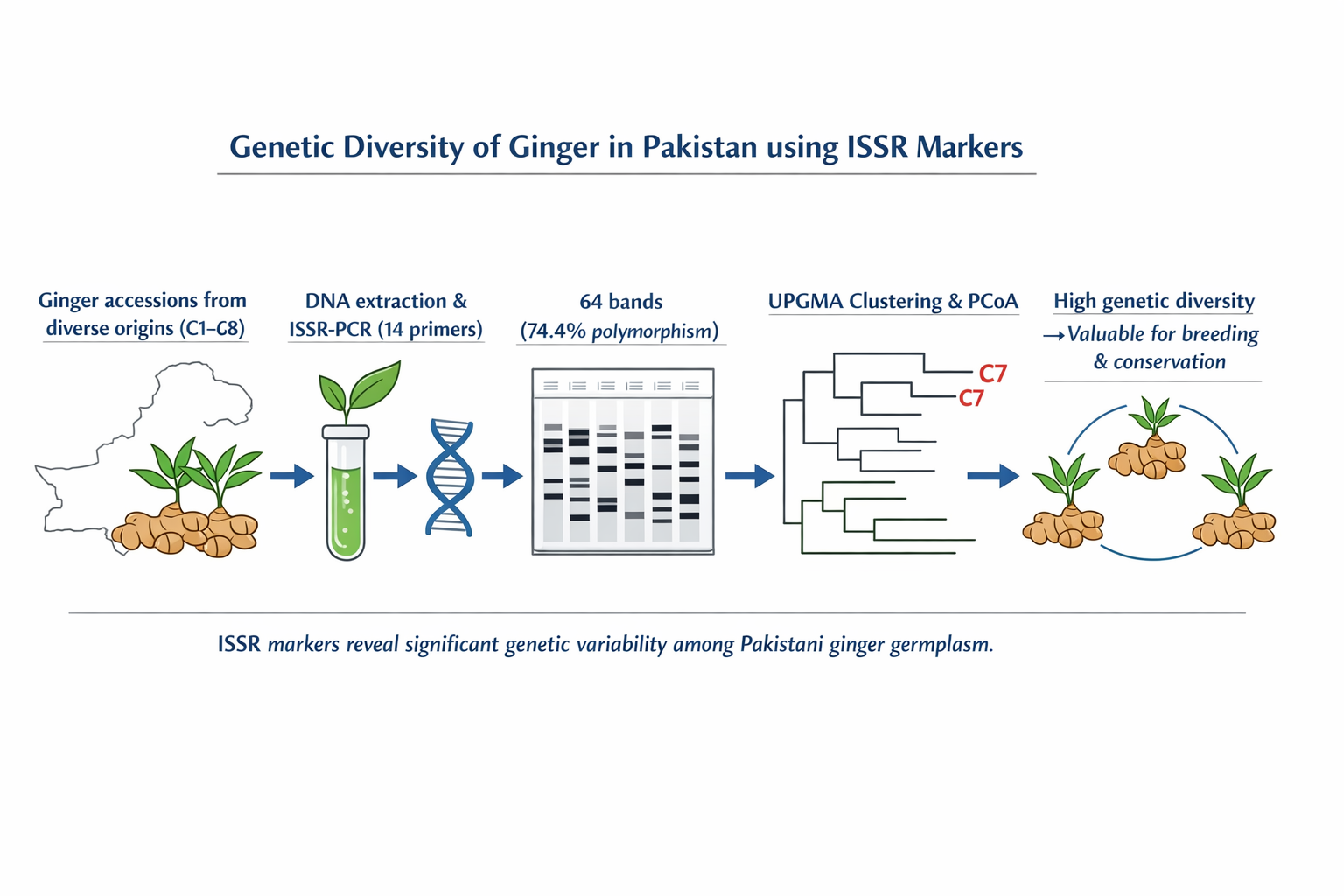
Ginger is an economically important crop with significant culinary and medicinal value. As a relatively novel crop in Pakistan, its production remains limited, with most germplasm imported from major ginger-producing countries, resulting in a narrow genetic base. This study assessed the genetic diversity of eight ginger accessions collected from different sources across Pakistan using Inter Simple Sequence Repeat (ISSR) markers. Fourteen ISSR primers generated 64 reproducible bands ranging from 150–1000 bp, of which 50 (74.4%) were polymorphic. Several primers, including UBC811, UBC808, ISSR-21, ISSR-4, and ISSR-1, exhibited 100% polymorphism, confirming the high-resolution power of ISSR markers. Cluster analysis (UPGMA) grouped the accessions into two major clusters primarily reflecting their trade origins, while Principal Coordinate Analysis (PCoA) supported these relationships. Notably, the Turkish accession (C7) was genetically distinct, indicating the presence of unique germplasm. Although basic morphological traits were recorded, molecular markers provided a more robust approach for assessing genetic relationships. The high level of polymorphism detected demonstrates the utility of ISSR markers for analyzing ginger diversity. This study establishes the first molecular baseline for local ginger accessions in Pakistan, providing valuable resources for germplasm conservation, breeding, and future genetic improvement programs.
Downloads
Published
Issue
Section
License
Copyright (c) 2026 SciNex Journal of Advanced Sciences

This work is licensed under a Creative Commons Attribution 4.0 International License.


 SCINEX PUBLISHERS