
Plant Disease Shifting Climate Change Related Landscapes: Host Vector Epidemiology Responses and Adaptive Management Solutions
Keywords:
Host–pathogen interactions, Climate-driven disease spread, Climate-smart agriculture, Crop resilience, Food securityAbstract
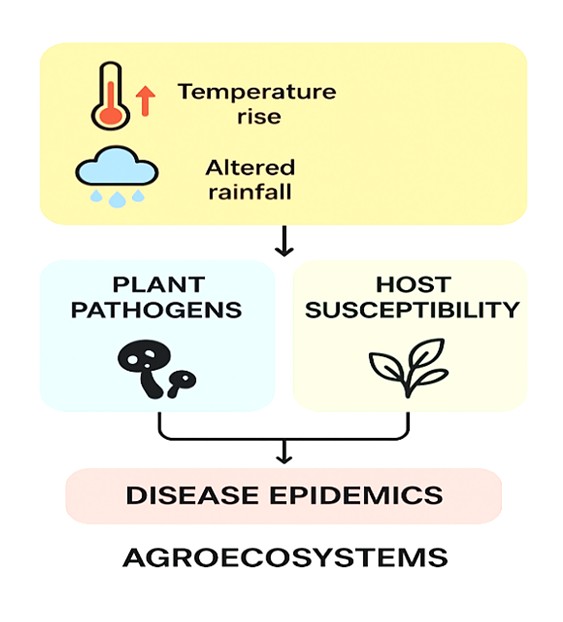
Plant disease dynamics are changing globally as a result of climate change which is radically changing the interactions between host plants, pathogens, insect vectors and their surrounding habitats. Plant defense mechanisms are being weakened by rising global temperatures, changing precipitation patterns, increased atmospheric carbon dioxide concentrations and an increase in the frequency of extreme weather events. Meanwhile pathogen survival, virulence, transmission efficiency and geographic expansion are being enhanced. These environmental factors have accelerated the spread of established infections into previously unaffected areas and contributed to the establishment of novel plant diseases. Concurrently the hazards of disease transmission in agricultural systems have grown due to climate induced changes in insect vector populations, such as greater population densities, extended periods of activity and expanded ranges. This main goal of this review is to assess adaptive and climate resilient management approaches while summarizing current developments in our knowledge of how climate change affects host vulnerability, pathogen behavior, vector ecology and plant disease epidemiology. Emerging diagnostic and monitoring technologies such as molecular diagnostics, remote sensing, unmanned aerial vehicles and artificial intelligence-based decision support systems that allow for early disease detection and better forecasting in dynamic climatic conditions are given special attention. The main finding of the reviewed literature is that integrated, climate smart frameworks that incorporate resistant crop varieties, sustainable cultural practices, biological control agents and sophisticated monitoring tools are necessary for effective plant disease management under present and future climate scenarios. To improve agro-ecosystem resilience, sustain agricultural yield and protect global food security in the face of accelerated climate change and these adaptive techniques must be strengthened.
Downloads
Published
Issue
Section
License
Copyright (c) 2026 SciNex Journal of Advanced Sciences

This work is licensed under a Creative Commons Attribution 4.0 International License.


 SCINEX PUBLISHERS